- INTERNET SERVICES Dial-Up (Analog 56K).
- DSL. DSL stands for Digital Subscriber Line. ...
- Cable. Cable provides an internet connection through a cable modem and operates over cable TV lines. ...
- Wireless. Wireless, or Wi-Fi, as the name suggests, does not use telephone lines or cables to connect to the internet. ...
- Satellite. ...
- Cellular.
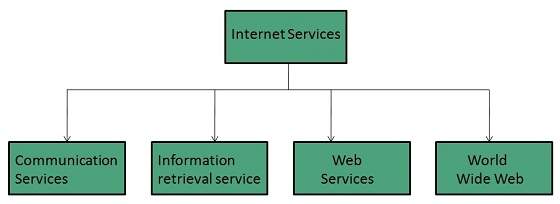
In 1979, Tom Truscott and Steve Bellovin, graduate students for Duke University, would create an early predecessor to dial-up Internet access – called the USENET. The USENET was a UNIX based system that used a dial-up connection to transfer data through telephone modems.[1] Dial-up Internet has been around since the 1980s via public providers such as NSFNET-linked universities and was first offered commercially in July 1992 by Sprint.[2] Despite losing ground to broadband since the late-1990s, dial-up may still be used where other forms are not available or the cost is too high, such as in some rural or remote areas Internet Services allows us to access huge amount of information such as text, graphics, sound and software over the internet. Following diagram shows the four different categories of Internet Services.
Communication Services
There are various Communication Services available that offer exchange of information with individuals or groups. The following table gives a brief introduction to these services:S.N. Service Description 1 Electronic Mail
Used to send electronic message over the internet.2 Telnet
Used to log on to a remote computer that is attached to internet.3 Newsgroup
Offers a forum for people to discuss topics of common interests.4 Internet Relay Chat (IRC)
Allows the people from all over the world to communicate in real time.5 Mailing Lists
Used to organize group of internet users to share common information through e-mail.6 Internet Telephony (VoIP)
Allows the internet users to talk across internet to any PC equipped to receive the call.7 Instant Messaging
Offers real time chat between individuals and group of people. Eg. Yahoo messenger, MSN messenger.Information Retrieval Services
There exist several Information retrieval services offering easy access to information present on the internet. The following table gives a brief introduction to these services:S.N. Service Description 1 File Transfer Protocol (FTP)
Enable the users to transfer files.2 Archie
It’s updated database of public FTP sites and their content. It helps to search a file by its name.3 Gopher
Used to search, retrieve, and display documents on remote sites.4 Very Easy Rodent Oriented Netwide Index to Computer Achieved (VERONICA)
VERONICA is gopher based resource. It allows access to the information resource stored on gopher’s servers.Web Services
Web services allow exchange of information between applications on the web. Using web services, applications can easily interact with each other.The web services are offered using concept of Utility Computing.
World Wide Web (WWW)
WWW is also known as W3. It offers a way to access documents spread over the several servers over the internet. These documents may contain texts, graphics, audio, video, hyperlinks. The hyperlinks allow the users to navigate between the documents.Video Conferencing
Video conferencing or Video teleconferencing is a method of communicating by two-way video and audio transmission with help of telecommunication technologies.Modes of Video Conferencing
POINT-TO-POINT
This mode of conferencing connects two locations only.
MULTI-POINT
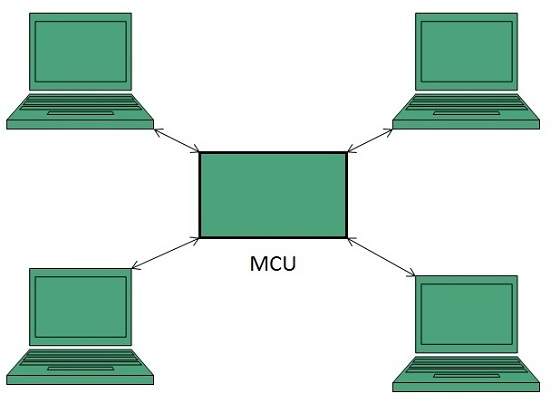
This mode of conferencing connects more than two locations through Multi-point Control Unit (MCU).